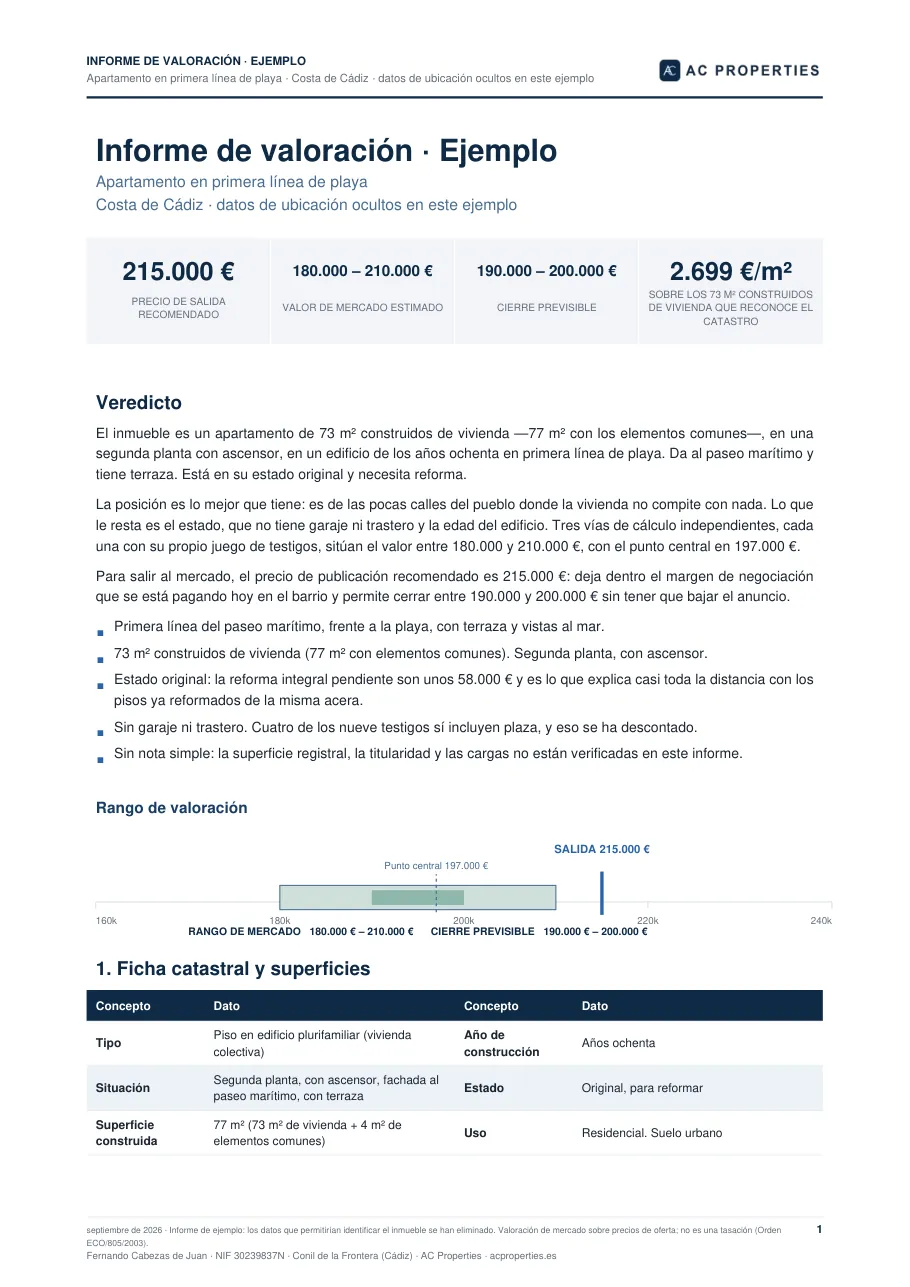
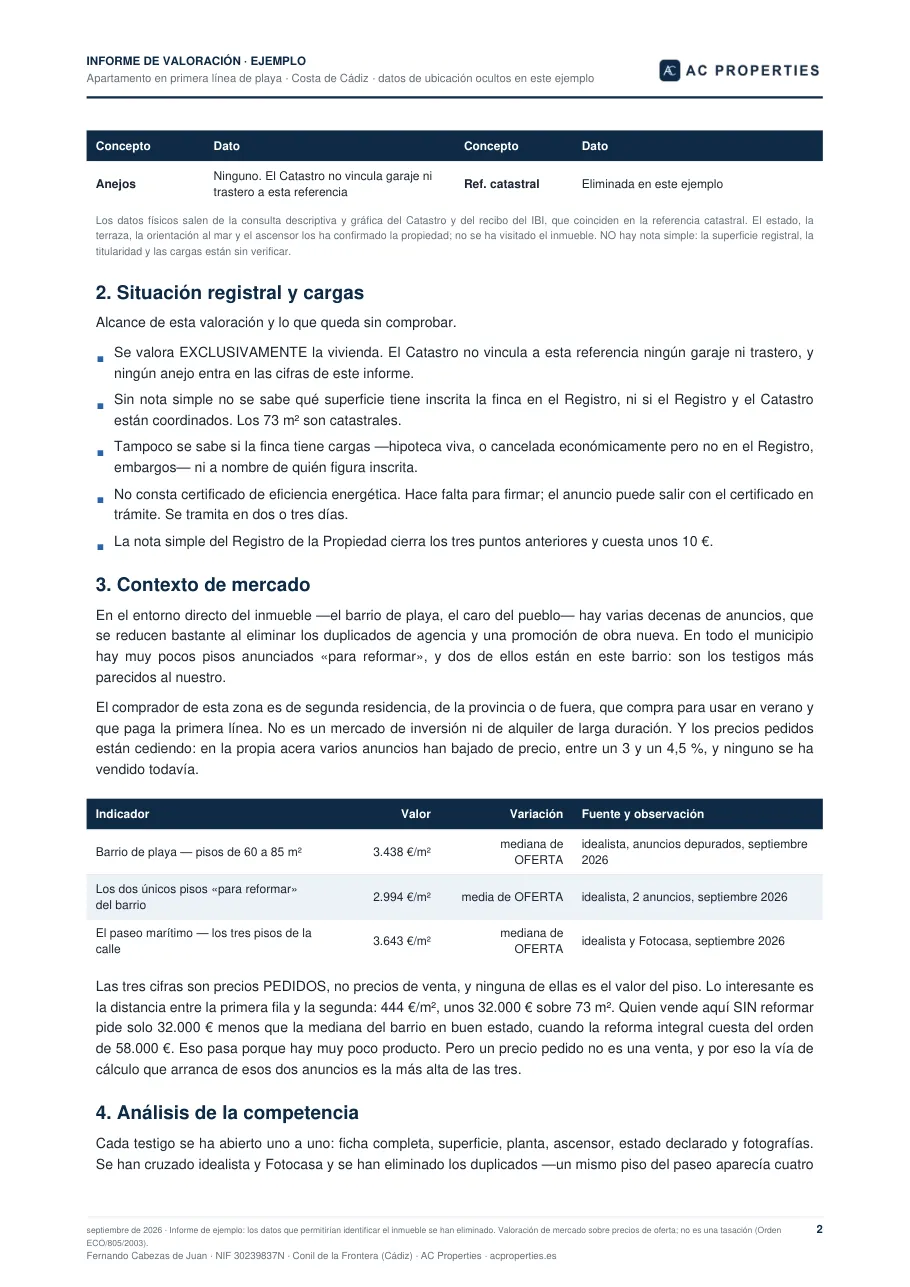
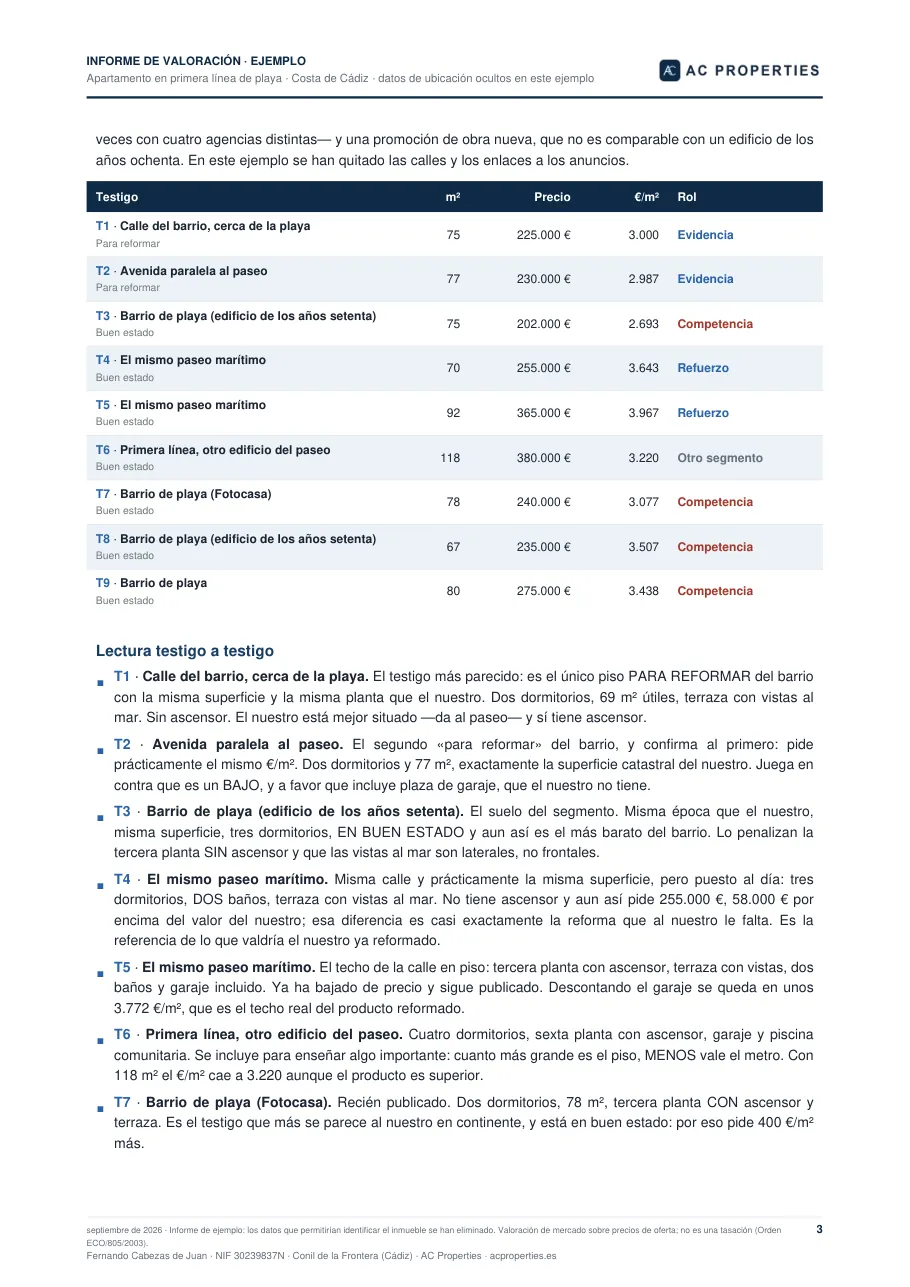
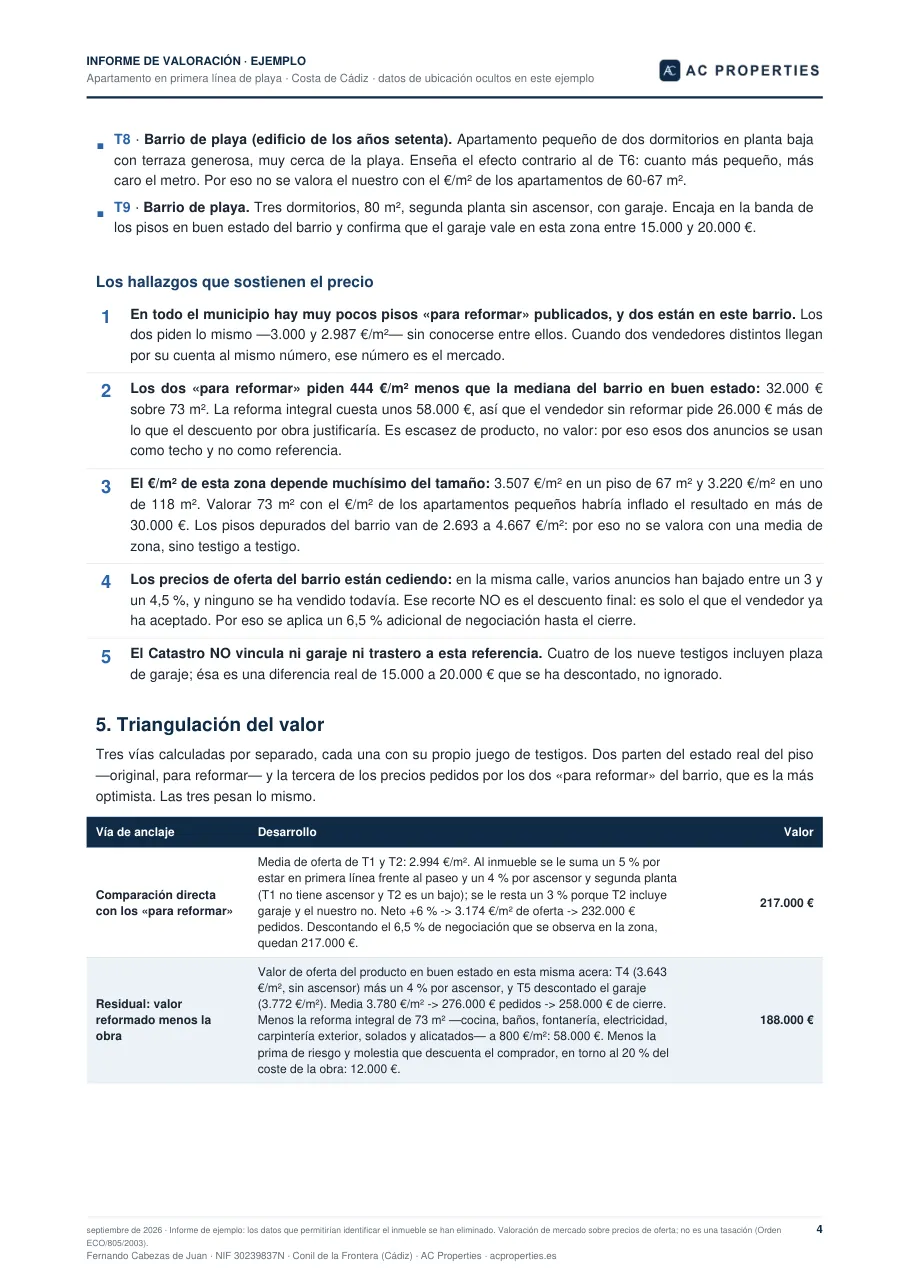
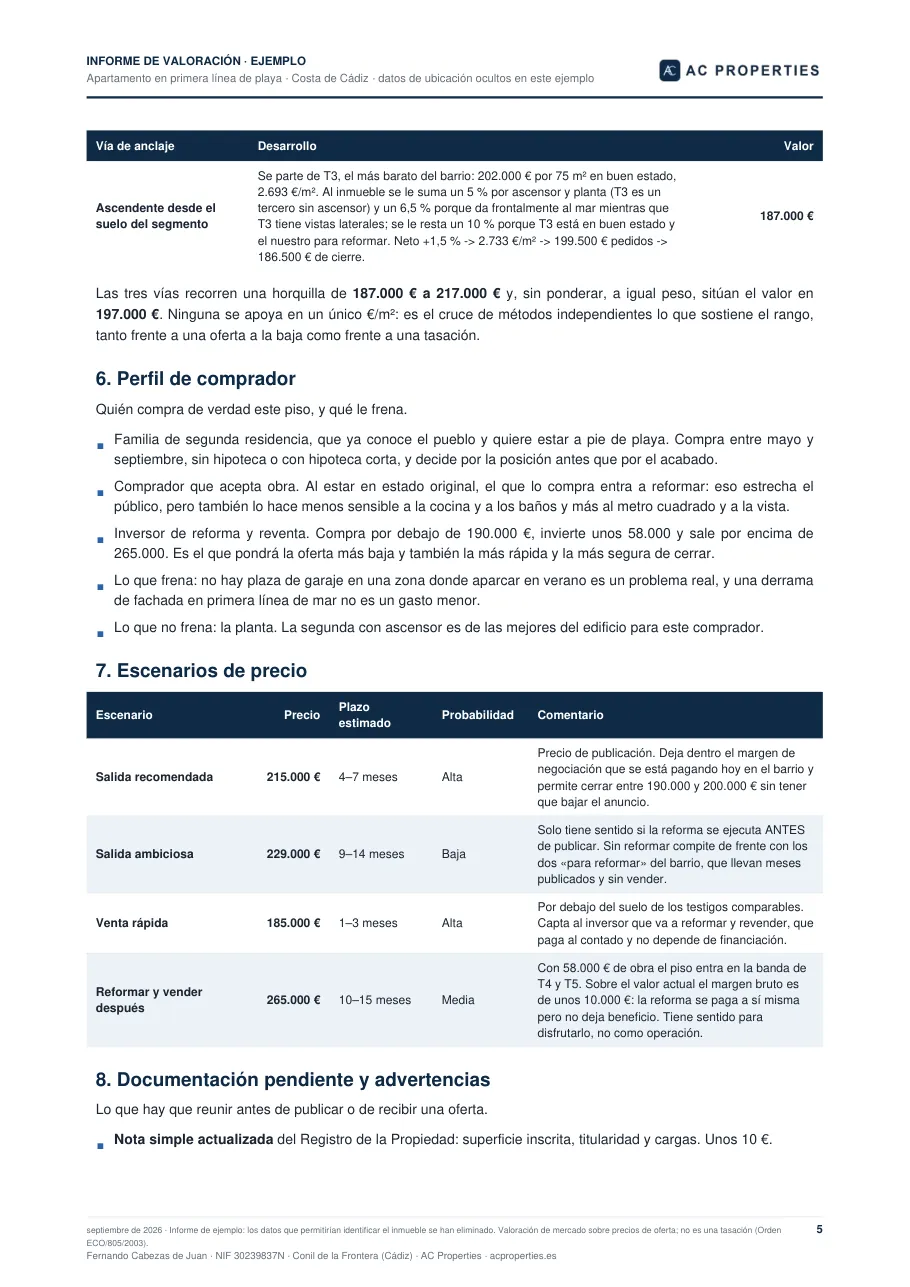
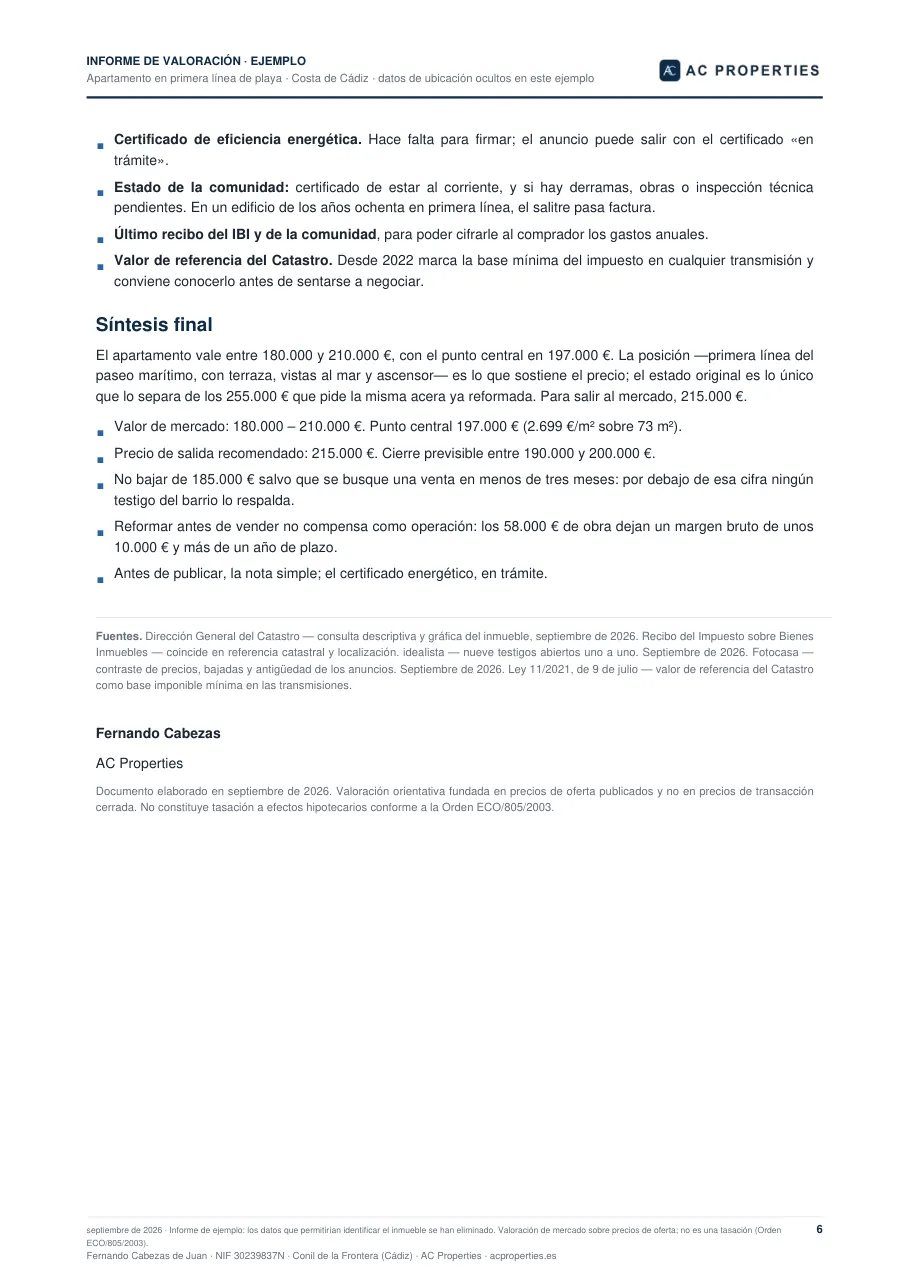
It is a real report we prepared in September 2026 on a beachfront flat on the Cádiz coast. To protect its owner we have removed anything that could identify it: the town, the streets, the cadastral reference and the links to the listings. The analysis and the figures are those of the report we delivered. The report itself is in Spanish; the explanations below are in English.
- Comparable («testigo»)
- A home for sale similar to yours (same area, similar size and age) that we use for comparison. Each one is opened individually: its listing, its photos, its floor, its condition. In Spanish they are called «testigos», witnesses, because they bear witness to what the market is asking for homes like yours.
- Evidence
- The comparable most like your home. In the sample, the only two flats in need of renovation in the neighbourhood, like ours.
- Support
- A comparable that confirms the valuation from another angle. In the sample, renovated flats on the same street: they show what the home would be worth renovated and, subtracting the works, what it is worth today.
- Competition
- The homes yours will compete with once it is on the market: buyers will see them at the same time. They show which price is credible.
- Different segment
- A comparable that is not close enough (much larger, a different type), but teaches something useful. In the sample, a 118 m² flat shows that the bigger the home, the less each square metre is worth.
- Asking price and sale price
- Listings show what the seller is asking, not what the buyer ends up paying. There is usually a negotiation in between. That is why we never value using asking prices as they are: we correct them for what is really negotiated in the area.
- Market value
- What your home is worth today, as a range. An honest range is more reliable than an exact figure: without seeing the inside, there are things nobody can know to the euro.
- Recommended listing price
- The price we recommend listing the home at. It sits somewhat above market value to leave room for negotiation, but not so far above that the listing goes stale without viewings.
- Expected sale price
- Where a sale normally ends up after negotiation, if the home is listed at the recommended price.
- Price per square metre (€/m²)
- The price divided by the built area. It lets you compare homes of different sizes, with a catch: large homes are worth less per square metre and small ones more. That is why a home cannot be valued by multiplying its size by an area average.
- Built area and communal areas
- The built area includes walls and partitions. For a flat, the Cadastre also adds a share of the building’s communal areas (entrance, stairs). We put it on the same scale as the listings so nothing is counted twice.
- Triangulation
- Calculating the value along three independent routes, each with its own comparables, and checking where they meet. If one calculation is wrong, the other two give it away.
- Residual value
- One of the triangulation routes: what the home would be worth renovated, minus the cost of the works and the risk taken by someone who buys to renovate.
- Land registry extract («nota simple»)
- A summary from the Land Registry showing the home’s registered size, who owns it and any charges (mortgages, embargoes). It costs about €10 and anyone can request it. With it, the valuation is much more reliable.
- Annex or separate property
- If the parking space or storage room is an annex, it is tied to the home and sold with it. If it is a separate registered property, it has its own value and can be sold separately. It changes the price, and the land registry extract says which it is.
- Energy certificate
- The document giving the home’s energy rating (A to G). It is needed to sell (the listing can go out while it is being processed) and takes a few days to obtain.
- Cadastral reference value
- A value set by the Cadastre for each property which, since 2022, is the minimum base for transfer tax (ITP) on the sale of a resale home. It is worth knowing before negotiating.
- Is it an official appraisal?
- No. An official appraisal, such as the one a bank requires for a mortgage, can only be issued by an appraisal company approved by the Bank of Spain. Our report is a market valuation: it tells you what the market is willing to pay for your home today, with its margin.